Cernit
The Calamitous BobCernit, known by the rank of Lieutenant Cernit, is the officer who brings Viviane Saint-Lys into the military and political world beyond the Deadlands. Initially encountered as the lead figure among approaching riders, he becomes the commander responsible for the defense of Fort Sky and one of Viviane’s most important early allies. His decisive significance lies in the way he converts an encounter threatened by language, cultural distance, and mutual suspicion into a working relationship without stripping Viviane of her independence.
Identity and First Encounter
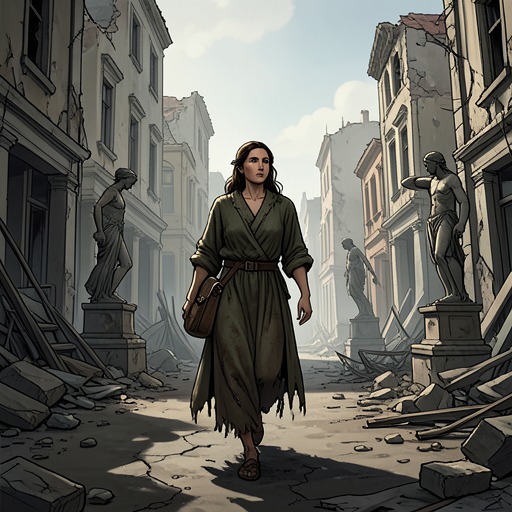
Cernit first appears as the lead figure of a mounted group that approaches Viviane without stopping, an action she reads as potentially hostile. She identifies him as a Baranese knight and responds by removing her hood and mask, exposing her face, and making broad waving gestures to show that she is not seeking a fight. The exchange immediately establishes the practical conditions of his character: he operates in an armed environment where danger must be assessed before trust is possible, but he is also willing to examine an unfamiliar figure rather than attack automatically.
The first barrier between them is language. Viviane speaks in Old Imperial, using an elegant register that sounds to Cernit like advanced military terminology. He recognizes the language and asks whether it is Old Imperial, while Benetti confirms the identification and attempts to translate. Cernit therefore enters the story not merely as a fighter but as an officer required to make judgments across linguistic and cultural boundaries. Viviane’s own name becomes part of this problem: when she asks to be called Viv, the golem’s pronunciation exposes that the local language never uses the sound represented by the letter v. Even a personal name must pass through the limits of the society receiving her.
Cernit introduces himself with pride and directness. Benetti introduces himself as well, as does the stoic Jor, after which Cernit begins questioning Viviane through Benetti’s imperfect translation. The conversation improves when Solfis identifies the language as a dialect of the Barrae nation and offers a more effective means of communication. This progression places Cernit within a chain of translation rather than presenting him as a fully informed authority: his command depends on intermediaries, local knowledge, and the willingness to continue speaking when ordinary communication fails.
Military Role and Command
Solfis summarizes Cernit’s position as part of a multinational corps of soldiers deployed at the edge of the Deadlands. The force presents its mission as a sacred duty under Neriad, the god of virtuous combat. Cernit consequently represents a frontier military institution whose daily work is shaped by both religious obligation and practical survival. His soldiers are not simply passing through the region; they are stationed where undead threats can turn into a wider catastrophe.
His competence becomes clearest in combat. The knights’ blades are designed to smash into creatures and drive them back without becoming lodged in withered flesh. With sufficient strength, a knight can cleave a target in two, although the soldiers usually do not waste effort on that. Cernit also possesses an uncanny ability to judge when a revenant will enter interception range and when it will be too slow to catch. He points out targets to Viviane with a grunt while she drains the odd revenant, allowing the spellcaster and the mounted fighters to complement one another. Their methods are different, but they are coordinated by battlefield timing rather than by a rigid attempt to make one serve as the other.
The soldiers’ discipline also reflects Cernit’s command. The undead detect the three knights from much farther away than they detect Viviane, suggesting that a larger expedition could trigger a small zombie apocalypse. The force therefore has to balance visibility, strength, and risk. Cernit’s military experience appears in this economy of action: the soldiers know what they are doing, and their methods are adapted to the specific ecology of the Deadlands rather than to abstract ideas of heroism.
At Fort Sky, Cernit organizes the defense around the terrain. The fortress stands on a small circular mound, reached by a single road that winds toward its fortified entrance, while sheer and vertiginous walls and cliffs protect every other side. He concentrates most of his forces forward, where he expects the principal attack. When the horde arrives on the tenth day, it is not a simple mass of undead but a layered formation: gut spillers, crawlers, and beasts occupy a circular center; fresher revenants form a surrounding ring; gaunt, caped figures stand at regular intervals; and a larger rabble of rotten bones and moaning flesh circulates around them. Cernit studies the approaching threat from the battlements before gathering almost everyone into the inner courtyard, leaving only a few lookouts. He gives Viviane the place of honor at his right side, formally recognizing her as a crucial participant in the defense.
Alliance with Viviane Saint-Lys
Cernit’s relationship with Viviane develops through negotiation rather than command. She asks who he is, learns his name, and uses Solfis as an interpreter while Cernit explains his corps and its mission. Although he is the officer, he does not treat her as an ordinary subordinate. The agreement they reach reflects both his limited resources and his respect for her status as an independent spellcaster.
Cernit is poor and can offer only his own stipend, a small payment by Viviane’s standards. His subordinates attempt to share their salaries, but he adamantly refuses to let them do so. Their willingness to sacrifice for him nevertheless moves him, and he compensates Viviane in other ways. He provides a room at the base of the tower, although the space is currently used as an officer’s mess and storage room. He arranges enough dry meat to feed her pet drake, supplies left over because the previous garrison lost half its numbers while fighting a mutated undead bat, and promises a letter of recommendation that can have her recognized as a mercenary in the service of Barran. He also acknowledges that she is her own woman and that, while she will help defend the fort, he cannot order her around.
This arrangement makes Cernit a threshold figure in Viviane’s passage from isolated survivor to recognized participant in the wider world. He cannot offer wealth, comfort, or complete security. What he can offer is institutional access, a place within a military community, practical provisions, and a document capable of opening doors in Param’s fragmented geopolitical environment, where mercenaries are common. His authority is therefore persuasive rather than absolute. He creates the conditions under which Viviane may cooperate without surrendering her autonomy.
Cernit also becomes a test of Viviane’s inherited attitudes toward power. She remembers her father’s habit of turning etiquette, measured language, and subtle gestures into instruments of control, and she recognizes how much that legacy shaped her own conduct. Cernit’s leadership contrasts with that manipulative model. He negotiates firmly, protects his soldiers from financial pressure, and accepts the limits of his authority instead of disguising them as personal superiority.
Honor, Guilt, and the Cost of Command
The moral center of Cernit’s character emerges through his treatment of the soldiers under him. After the battle, Viviane tries to find Jor but cannot identify him beneath the corpses and burning remains. Benetti is found, or what remains of him, and Cernit helps gather the pieces with reverence. He retrieves Benetti’s enchanted sword, still embedded in the face of a dead crawler, sheathes it, and ties a rope around the hilt. When he says “Family,” the gesture becomes a military burial rite in miniature: the dead are not anonymous material, even when the battlefield has reduced their bodies to indistinguishable fragments.
Cernit’s handling of Benetti’s remains also gives shape to the story’s concern with moral injury. Benetti believes that he deserves to be at the frontier because he once harassed women with foolish friends and went too far with a woman who mattered. He understands his deployment as punishment and hopes that the soldiers can save the undeserving together. Cernit does not erase this guilt, but his actions after Benetti’s death refuse to reduce the disgraced man to his past offense. By collecting him as family, he recognizes both the wrong Benetti committed and the person he became through service and sacrifice. The ritual does not prove that redemption is complete, especially because the victim might disagree, but it prevents the dead man from disappearing into the mass of corpses.
Cernit’s concern is not limited to the dead. Viviane asks whether Jor is still alive, and Solfis reports that Jor was alive when brought to the fort but had been wounded by an undead creature. The question places Cernit’s command under a continuing moral obligation: survival is not secured merely because a soldier has been carried behind the walls. The later inability to find Jor after the battle gives that concern a darker outcome, showing how command must confront the limits of recognition, rescue, and mourning.
Historical Knowledge and Continuing Function
Cernit serves as an important source of political context once Viviane begins preparing to leave the frontier. He explains that Baran lies in the far east of the continent and that Kazar belongs to Enoria, a kingdom that had once been a major power before splitting fifteen years earlier. The division followed a king’s attempt to purge the nobility after a failed coup: he replaced a third of the nobles with sycophants, provoked a rebellion by one of his strongest allies, and presided over a bloody two-year civil war before his death. His son succeeded him, after which both sides withdrew to recover.
This history broadens Cernit beyond the immediate defense of Fort Sky. He is not only a frontier officer fighting the undead; he is also a practical guide to the fractured political order through which Viviane must travel. His information helps connect the Deadlands to the kingdoms beyond them and makes the military alliance consequential after the immediate crisis has passed.
Cernit’s encounters with language continue to define his function. Later, when another sergeant asks whether Viviane speaks the local language, she answers that she speaks Old Imperial, and the man understands isolated words because they are close or identical to that older tongue. Cernit’s earlier recognition of Old Imperial thus anticipates a broader pattern in which the language of the old imperial world remains a partial bridge across divided societies. His role is to keep that bridge usable, even when neither side possesses complete fluency.
Cernit’s narrative importance comes from this combination of limits and responsibilities. He is neither an all-powerful commander nor a purely symbolic knight. He commands a small, endangered force, lacks money to pay the extraordinary ally who arrives at his post, must rely on translation, and cannot save every soldier. Yet he compensates for those limitations with tactical judgment, respect for independent actors, and a concrete ethic of care. His place at the defense of Fort Sky and beside Viviane marks the formation of a temporary community whose bonds are proved not by ceremony alone, but by who shares danger, who refuses to exploit weakness, and who gathers the dead when the battlefield has made them almost impossible to recognize.